It usually happens on a Sunday evening. The kitchen is thick with the warm, toasted scent of cumin and coriander, the curry is gently simmering, and you are anticipating the deep comfort of a home-cooked Indian meal. Over on the back ring of the hob, your pot of rice is bubbling away. You have measured the water meticulously, set your timer, and now you wait with that familiar, quiet anxiety before taking the lid off.
The moment of truth arrives. You lift the lid, expecting individual, snow-white needles of grain that separate with a gentle fluff of a fork. Instead, you find a claggy, starchy mass at the bottom, or worse, chalky centres that stick stubbornly to your teeth. The disappointment is remarkably visceral when a seemingly simple side dish undermines the entire main event.
We are taught from our earliest days in the kitchen that boiling rice is a matter of strict, unforgiving mathematics. The packet demands one cup of dry grains to exactly one and a half cups of water. We watch the clock, turn down the heat to a simmer, and cross our fingers. But this rigid mathematical approach completely ignores the fundamental physics of how a slender grain of basmati actually cooks.
The finest Indian restaurants in London, Birmingham, and Manchester do not rely on perfect liquid ratios to achieve their impossibly light, fragrant mounds of rice. They rely on something far more forgiving and organic. They manipulate the captive steam, turning a violent, starchy boil into a gentle, restorative vapour bath.
The Perspective Shift: From Boiling to Breathing
Cooking basmati is not akin to boiling pasta. It is much closer to coaxing a dry sponge back to life in a gentle sauna. When you attempt to boil basmati until the water is absorbed, the violent agitation of the rolling water constantly knocks the delicate grains together. They fracture and break, bleeding their internal starches out into the surrounding water, which rapidly turns into a gluey paste. You aren’t really cooking the rice; you are drowning it.
The perspective shift required here is profound but brilliantly simple. Water is merely the vehicle; steam is the actual chef. The secret is not finding the magical, precise measurement of liquid. The true professional pivot is trapping the vapour so perfectly that the grains plump up in their own suspended atmosphere, free from the turbulent, starchy water.
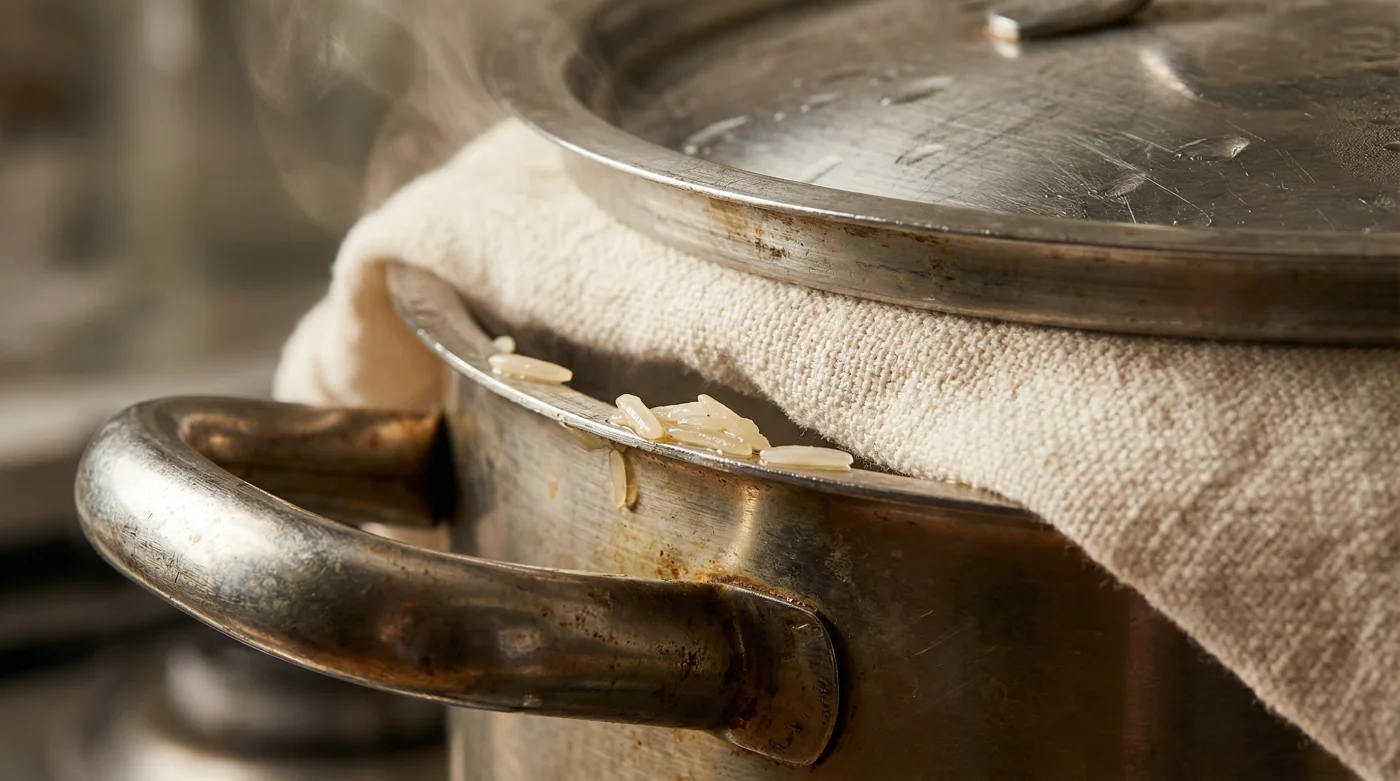
Anika Patel, a 58-year-old banquet chef who orchestrates grand feasts for hundreds along Leicester’s bustling Golden Mile, views the British home cook’s obsession with measuring jugs with mild amusement. “You cannot force the grain,” she explains, deftly stretching a clean, woven tea towel across the rim of a massive biryani pot before jamming the heavy lid down over it. This simple cloth acts as a breathable membrane. It absorbs the heavy, excess condensation that usually drips back down from the lid to turn the top layer to mush, whilst simultaneously keeping the essential, dry steam trapped inside. It is a two-ingredient modification: just ambient heat and a standard cotton towel.
Tailoring the Vapour: Adapting the Technique
Not all kitchen setups are identical, and understanding how to adapt this method requires a little intuition. Your equipment dictates the rhythm, but the fundamental rule of the towel remains constant across all variations.
For the Purist (The Pre-Soak)
If you buy aged, extra-long grain basmati in 10-kilogram hessian sacks, the grain demands a certain level of respect. Wash it in a bowl until the water runs completely clear, removing all surface dust, then soak it in cold water for thirty minutes. The towel trick here acts as the final polish. You are gently steaming grains that have already absorbed their base requirement of moisture, resulting in grains that stretch to almost twice their original length.
For the Busy Parent (The Rapid Rinse)
The towel becomes your safety net when you are rushing to feed the family on a dark Tuesday night and soaking is an impossible luxury. Rinse the rice fiercely under cold water in a sieve for one minute to remove the worst of the surface starch. Because you haven’t pre-soaked, the dry steam trapped by the cloth forgives your lack of preparation, ensuring the core of the grain still cooks through beautifully without turning the outside to sludge.
For the Batch Cooker (The Fridge Revival)
Cooked rice loses moisture rapidly in the cold environment of a fridge, turning hard and unpalatable. When reheating yesterday’s batch, sprinkle a single tablespoon of cold water over the grains, cover the bowl tightly with your damp tea towel, and microwave or gently steam on the hob. The towel breathes life back into the hardened starch, recreating that fresh-out-of-the-pot texture.
Mindful Application: The Two-Ingredient Restaurant Pivot
Implementing this technique requires setting aside your measuring jug anxiety. Focus entirely on the sensory cues rather than staring at the clock, turning a previously fraught process into a quiet, deliberate kitchen ritual.
Begin by bringing a large, generously salted pan of water to a rolling boil—just as you would for pasta. Drop your rinsed basmati directly into the vigorous water. Do not cover the pot yet. Let the rice dance freely for exactly five to six minutes. You are looking for a grain that is tender on the outside but still yields a distinct, firm bite when you crush it between your teeth.
Immediately drain the rice through a fine sieve, shaking off all the excess water. Return it to the empty pot, keeping it entirely off the heat.
- Drape a clean, dry cotton tea towel tightly over the open rim of the pot.
- Push the heavy lid down firmly over the towel to create a tight, pressurised seal.
- Gather the overhanging corners of the cloth and fold them up over the lid handle (this is vital to prevent a fire hazard).
- Place the sealed pot back onto the hob on the absolute lowest heat setting your stove can manage.
The Tactical Toolkit:
- Temperature: A rolling boil for the initial phase, followed by the lowest possible simmer for the steaming phase.
- Time: 5 minutes of boiling, 10 minutes of covered steaming, and crucially, 5 minutes of resting completely off the heat before lifting the lid.
- Tools: A heavy-bottomed pot to distribute heat evenly, a tight-fitting lid, and a standard woven cotton tea towel (never use synthetic fabrics or thick terrycloth).
The Quiet Confidence of Capability
Mastering your basmati rice fundamentally alters how you approach your kitchen environment. It entirely removes a persistent, frustrating point of failure from your regular culinary repertoire, allowing you to focus your attention on the complex spices and sauces of your main dish.
When the resting time is up and you pull away the warm towel to reveal a mountain of separate, fragrant, perfectly upright grains, you aren’t just serving dinner. You are serving hard-won confidence. You have successfully transitioned from blindly following a flawed packet instruction to truly understanding the physical reality of the food in front of you.
You no longer need to fear the dreaded starchy sludge or the burnt bottom layer. By trusting the gentle, restorative power of trapped steam and a simple piece of cotton cloth, you bring a genuine touch of restaurant precision right into your own home, making every meal feel like a quiet victory.
“A perfect grain of rice should stand up to greet you when the lid is lifted—separate, proud, and born of gentle steam rather than drowned in boiling water.”
| Method | Mechanics | Your Payoff |
|---|---|---|
| Standard Boiling | Exact water ratio absorbs into the grain until dry. | High risk of burnt bottoms and mushy, broken tops. |
| The Towel Trick | Rapid par-boiling followed by sealed, low-heat steaming. | Flawless, distinct, and highly fragrant grains every single time. |
| The Microwave Hack | Blasting with intense heat in a sealed plastic container. | Chewy, uneven texture that lacks delicacy and aromatics. |
Frequent Kitchen Queries
Is it safe to put a tea towel on the hob?
You must ensure all four corners of the cloth are folded up securely over the top of the lid, well away from the heat source beneath the pot. Never leave it completely unattended.Can I use a damp towel instead of a dry one?
A dry cotton towel is far superior as its primary job is to absorb the excess condensation that drops down from the cold lid, preventing your rice from becoming soggy.Does this exact method work with brown basmati rice?
Yes, the mechanics are identical, but the initial violent boiling time must be increased to around 15 to 20 minutes before you drain and apply the towel.Why is my finished rice still slightly chalky in the middle?
You likely did not boil it quite long enough before draining. The grain should be tender on the very outside but still retain a firm bite in the centre before the steaming phase begins.Should I rest the rice after the steaming phase?
Always. Leaving the pot completely off the heat for five minutes before removing the towel allows the starch structure to set, preventing the delicate grains from breaking when you fluff them.