Picture a damp Sunday morning. The kettle has just clicked off, and the sharp, acidic scent of poaching vinegar hangs heavy in the kitchen air, waiting for the eggs. You stare down at the glass bowl balanced precariously over a pan of simmering water on the hob. This is the traditional gauntlet of the Sunday brunch: the dreaded bain-marie.
Your arm begins to ache as you furiously beat the pale egg yolks, praying silently that they do not curdle into a sad, scrambled ruin. The anxiety of pouring clarified butter in a razor-thin stream while maintaining a frantic whisking pace completely destroys the quiet peace of your morning.
But what if the sweat, the tension, and the aching forearm are entirely unnecessary? The culinary world has long perpetuated a myth that sheer physical force and a precarious water bath are the only legitimate ways to bind liquid fat and water together into a smooth sauce.
You are being actively misled by generations of rigid classical training. The secret to a velvet, spoon-coating emulsion does not live in the frantic rotation of your wrist; it lives entirely in the exact thermal energy of the fat. A standard 800W microwave can achieve in ninety seconds what usually takes ten minutes of intense, hovering anxiety.
The Perspective Shift: Stop Whisking, Start Melting
Emulsifying a hollandaise is often explained to home cooks as a battle of wills, forcing two opposing liquids to tolerate one another through sheer mechanical blending. If you think of it like trying to mix oil and water by simply shaking them violently in a jar, it is no wonder the sauce splits the moment you turn your back to check the bacon.
Temperature acts as a key, turning the delicate lock on the egg yolks. When butter is heated to precisely 90 degrees Celsius, it holds enough ambient energy to gently cook the yolks instantly on contact, forcing their proteins to swell and securely trap the fat droplets. The aggressive heat does the heavy lifting, not your whisk.
Consider Julian, a 42-year-old head chef running a perpetually overbooked, clattering brunch spot in the heart of Bristol. On a typical Sunday service, amidst the shouting of orders and the hiss of the espresso machine, he pushes out well over two hundred plates of Eggs Benedict. He does not employ an army of exhausted apprentices to stand over boiling pots of water with wire whisks.
Julian relies on thermal shock, treating the sauce as a guaranteed science rather than a culinary dark art. He uses a heavy jug of butter, brought to a rolling, aggressive boil in a commercial microwave, poured directly into a standard blender housing the cold yolks. The sheer heat creates a perfectly stable ribbon of golden sauce that holds its temper beautifully for hours on the pass.
Adjusting the Velvet: Segmented Variations
Not all brunch tables are created equal, and your approach to this rich, buttery drape should flex naturally to suit the specific occasion. Once you master the foundational thermal trick, the base emulsion becomes a blank canvas for your own palate.
For the Sunday Purist, the classic flavour profile remains untouchable. Reduce a tablespoon of good quality white wine vinegar with a shallot and cracked black peppercorns, straining this sharp liquid into your raw yolks before the hot butter hits. Finish with a firm squeeze of fresh lemon and a faint dusting of cayenne pepper.
For the Time-Poor Parent, you simply do not have the luxury of reducing vinegars while children are demanding sustenance. Drop two raw yolks, a pinch of sea salt, and a dash of bottled lemon juice into a tall measuring jug. Blitz it with an immersion blender while you slowly pour in the boiling butter, taking exactly three minutes from the fridge to the dining table.
For the Adventurous Palate, you can push the boundaries of depth and nuttiness. Allow your butter to bubble in the microwave just long enough that the milk solids drop to the bottom and turn a deep, toasted hazelnut brown. Pouring this fiercely hot brown butter into your yolks creates a roasted, deeply savoury variation that transforms simple roasted asparagus into a masterpiece.
Mindful Application: The Microwave Method
Remove the panic entirely from the cooking process by establishing a clear station before you begin. Gather your ingredients, ensuring the yolks are cleanly separated and resting at the bottom of a tall, narrow jug, waiting for the heat.
Precision creates absolute culinary calm when you follow the strict mechanics of the method without rushing.
- Place 150g of unsalted butter in a microwave-safe jug, covering it loosely with a small plate to prevent any violent splattering.
- Microwave on full power for roughly 60 to 90 seconds until it is fiercely bubbling and spitting audibly.
- Place two large egg yolks, a teaspoon of fresh lemon juice, and a generous pinch of fine sea salt in a separate tall container.
- Lower your stick blender directly into the yolks and turn it on to a steady, continuous speed.
- Pour the furiously hot butter down the side of the container in a steady, thin, unwavering stream.
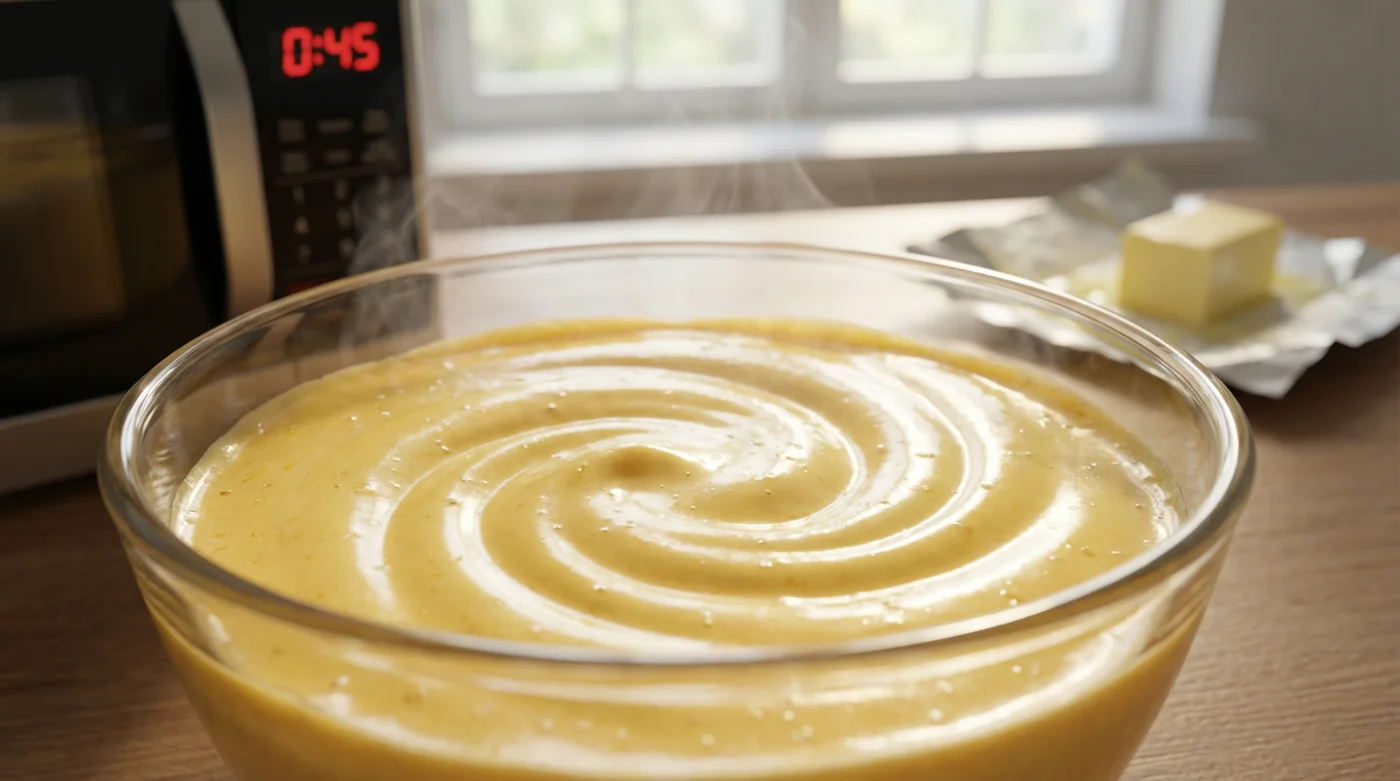
- Watch closely as the pale yellow liquid instantly billows up into a thick, opaque, trembling cream.
The Tactical Toolkit for this operation is wonderfully minimal. You need a reliable stick blender, a heavy-bottomed glass microwave jug, and butter that has reached at least 90 degrees Celsius. If the butter is just gently melted and lukewarm, it simply will not cook the eggs, leaving you with a stubbornly thin, soupy disappointment.
The Bigger Picture: Reclaiming Your Morning
You are buying back time and completely eliminating the stress of hosting. When you no longer fear the tragic split of an expensive sauce, you stop viewing the kitchen as a place of high-stakes tension and start seeing it as a space of relaxed, generous provision.
Mastering this specific trick is about so much more than just pouring a rich, yellow ribbon over smoked salmon and toasted sourdough. It is about actively dismantling the lingering intimidation that surrounds classic, supposedly difficult French cookery.
The gentle hum replaces panic, trading the frantic clatter of a whisk against glass for the quiet efficiency of modern tools. You can sip your morning tea, calmly plate your perfectly poached eggs, and serve a dish that tastes of pure luxury, safe in the knowledge that the hardest part was simply pressing a button.
Emulsion is a quiet dance of temperature and timing, never a desperate test of your physical endurance.
| Method | The Technical Detail | Added Value for You |
|---|---|---|
| The Traditional Bain-Marie | Requires constant, frantic whisking over simmering water for ten to fifteen minutes. | High risk of scrambling the eggs, splitting the sauce, and causing severe arm ache. |
| The Microwave Method | Boiling butter poured slowly into raw yolks via a stick blender in just ninety seconds. | Creates a flawlessly stable, thick sauce with absolutely zero physical fatigue. |
Frequently Asked Questions
Why did my sauce turn out too thin and watery? Your butter was simply not hot enough. It needs to be aggressively bubbling and spitting to properly cook the yolks and thicken the emulsion upon contact.
Can I rescue a split microwave hollandaise? Yes, you can. Place a fresh egg yolk and a splash of warm water in a clean jug, blend it, and very slowly pour your split mixture into it to re-emulsify.
Do I strictly need to use clarified butter? Not at all. Whole melted butter works perfectly with this specific method, providing a slightly creamier, richer mouthfeel thanks to the retained milk solids.
How long can I safely keep the finished sauce warm? You can store it in a pre-warmed thermos flask for up to two hours. Do not attempt to put it back in the microwave to reheat, or it will instantly curdle.
Can I use a standard jug blender instead of a stick blender? Absolutely. Just ensure you remove the small centre cap in the lid so you can safely and slowly pour the hot butter through while the blades are running.