The kitchen smells of rendered fat, rosemary, and the slow, comforting warmth of a Sunday afternoon. You have done everything correctly. The potatoes have that glass-like crunch, the Yorkshire puddings are standing tall, and the beef has been resting under a tent of foil for a good forty-five minutes. You whet the carving blade, feeling the anticipation of a well-earned meal.
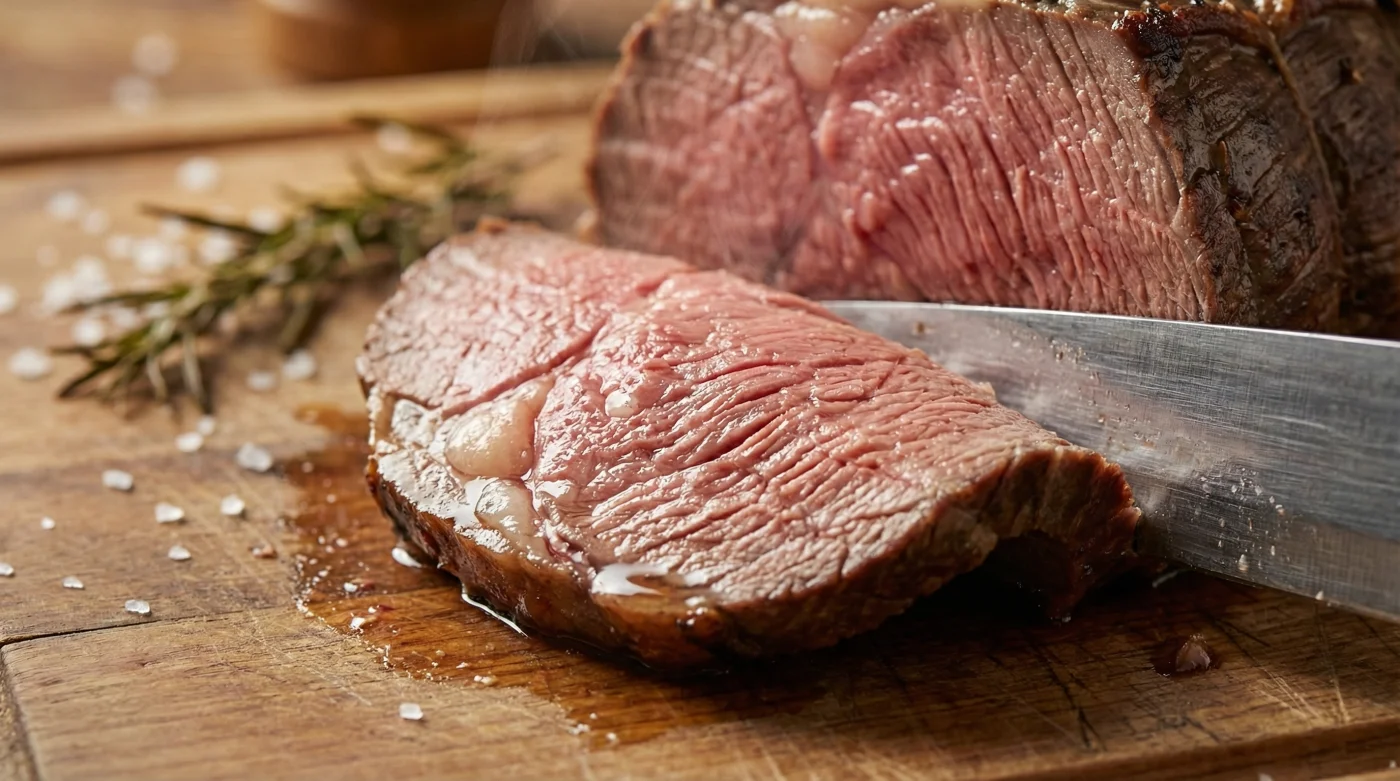
But as the steel meets the meat, a quiet tragedy unfolds. You press down, slicing neat, perfectly vertical discs. They look the part on the platter, yet the moment you take a bite, the illusion shatters. The meat demands effort. It pulls, it tires the jaw, and despite the premium price tag from the butcher, it eats like a pair of old boots.
We are taught that patience is the primary currency of roasting. We believe that if we just let the meat relax, the juices will redistribute, and tenderness is guaranteed. Resting is entirely non-negotiable, but it is only half the equation. The final, irreversible texture of your Sunday lunch is determined in the last thirty seconds of prep.
The secret does not lie in the heat of the oven or the pedigree of the cow. It lies in the geometry of your wrist. Slicing straight down might feel intuitive, mirroring the shape of the joint, but it is the quickest way to preserve the rigid, chewy structure of the animal’s muscle fibres.
The Perspective Shift: Treating Meat Like Timber
Imagine a thick, robust rope made of thousands of tightly wound threads. If you chop that rope straight across into small blocks, each block remains a cluster of unbroken, stubborn strings. Your teeth are left to do the exhausting work of separating them. This is precisely what happens when you slice a joint vertically.
You need to change your relationship with the carving board. Think of a master carpenter working with timber. A craftsman knows that to manipulate wood, you must interact with the grain. Muscle fibres in a roasted joint behave exactly the same way. By tilting your blade to a 45-degree angle—slicing diagonally down and across those structural threads—you create a completely different eating experience.
This angled approach mechanically breaks the bonds that heat and resting cannot touch. A 45-degree slice drastically shortens the individual fibres, rendering them fragile. Suddenly, a relatively ordinary topside or silverside surrenders in the mouth, delivering a buttery bite that mimics cuts costing three times as much. You are no longer just portioning food; you are engineering its texture.
For Arthur Pendelton, a 64-year-old retired master butcher from Harrogate, watching people carve meat is an exercise in restraint. Arthur spent forty years breaking down carcasses and advising nervous home cooks on Christmas Eves. “They buy a beautiful fore-rib,” he notes, pouring a cup of strong tea, “and they hack it like they’re felling a tree. If you want it to melt, you have to flatter the meat. Drop your wrist. Let the blade slip through at a slant. You’re trying to whisper to the fibres, not shout at them.”
Adapting the Angle: A Guide to the Sunday Joints
Not all roasts share the same structural integrity. The way you apply this 45-degree rule must adapt to the beast on the board. The goal is always to make the plated meal look expensive and refined, but the approach shifts slightly depending on your provision.
For the Lean Contender
Beef topside and silverside are weekend staples across the UK, prized for their clean flavour and lack of heavy fat. However, they are hard-working muscles. Here, the 45-degree angle is absolutely crucial for the texture. You want to slice thinly, letting the diagonal cut maximise the surface area. The meat will drape beautifully on the plate, absorbing gravy like a sponge rather than letting it pool on a flat surface.
For the Rich Centrepiece
A bone-in rib of beef or a rolled sirloin carries its own buttery marbling, but careless carving will still render it surprisingly tough. Remove the meat from the bone first in one clean sweep. Then, apply the 45-degree slice to the isolated muscle. Because of the internal fat, you can afford a slightly thicker cut—around half an inch—while still guaranteeing a yielding, luxurious bite.
For the Awkward Shapes
A leg of lamb presents a topographical challenge. The bone runs at an angle, and the muscles run in multiple directions. Start parallel to the bone, taking off a large lobe of meat entirely. Once that piece is flat on your board, ignore its original shape. Find the direction of the grain, tilt your knife 45 degrees, and carve across it. The result is elegant, uniform slices that look like they belong in a fine-dining room, rather than a ragged pile of uneven offcuts.
The Geometry of Tenderness: Executing the Cut
Mastering this technique requires a moment of quiet focus before the chaos of serving up. It is not about speed; it is about deliberate, mindful positioning. Stand square to your carving board, ensuring it is anchored with a damp cloth underneath to prevent slipping.
Identify the direction in which the muscle lines are running. Turn the meat so these lines run horizontally in front of you, from left to right. Place your non-dominant hand firmly on the roast to steady it. Drop your elbow slightly, allowing the knife to naturally find that 45-degree tilt.
- Rest the heel of the blade against the meat at the chosen angle.
- Use the entire length of the knife, pulling back toward yourself in long, smooth strokes.
- Do not saw aggressively; let the sharpness of the steel do the parting.
- Keep the angle consistent for every slice to ensure uniform cooking and texture.
The Tactical Toolkit
- The Blade: A 10-inch to 12-inch hollow-ground carving knife. Avoid serrated bread knives at all costs; they tear rather than slice.
- The Temperature: The meat must be resting at around 45°C to 50°C internally before carving, allowing the fibres to relax enough to accept a clean cut.
- The Resting Period: Minimum 30 minutes for medium joints, up to 50 minutes for large ribs, loosely tented in foil.
- The Angle Check: If the face of your slice looks like a tight checkerboard, you have nailed the 45-degree cross-grain cut. If it looks like long, parallel lines, you need to adjust your wrist.
Beyond the Gravy Boat: The Respect of the Roast
We put a tremendous amount of emotional pressure on the Sunday lunch. It is one of the few meals where households still gather at a specific hour, pausing the rush of the week to share a table. When you serve a piece of meat that requires a steak knife and a strong jaw, it breaks the relaxed atmosphere.
Mastering the 45-degree carve is an act of quiet hospitality. It removes the mechanical friction from the plate. You are taking an everyday ingredient and, through nothing but technique and geometry, presenting it at its absolute pinnacle. It allows your guests to focus on the conversation, the roast potatoes, and the company, rather than fighting with their food.
Ultimately, it proves that brilliant cooking is rarely about spending more Pounds Sterling at the butcher counter. It is about understanding the physical reality of what you are preparing. A slight tilt of the wrist, a deep breath before the cut, and a willingness to work with the grain—these small, deliberate acts turn a good roast into something unforgettable.
“The knife is merely an extension of your respect for the ingredients; tilt the blade, and you completely alter how a meal is remembered.” — Arthur Pendelton, Retired Master Butcher.
| Key Point | Detail | Added Value for the Reader |
|---|---|---|
| Straight Vertical Slicing | Cuts down with the grain, leaving long muscle fibres intact. | Explains why expensive joints often turn out chewy despite perfect oven times. |
| 45-Degree Diagonal Slice | Cuts across and through the grain at a slope, shortening fibres to mere millimetres. | Creates a ‘melt-in-the-mouth’ texture, making budget joints feel luxurious. |
| Visual Identification | The grain looks like parallel lines running across the surface of the raw or rested joint. | Removes the guesswork from carving, ensuring you always know where to place the blade. |
Frequently Asked Questions
Does resting time matter if I use the 45-degree angle?
Absolutely. Resting relaxes the fibres and allows juices to thicken. Carving a hot joint, even at an angle, will cause all the moisture to bleed out onto your board, leaving the meat dry.Can I use this technique on poultry like roast chicken or turkey?
While poultry breasts do not have the same tough, distinct grain as beef or lamb, slicing at a slight bias across the breast meat still creates a wider, more elegant slice that feels softer on the palate.What if I cannot find the grain on a heavily roasted joint?
Cut a tiny, vertical tester slice from the very end of the joint. Look at the exposed face of the meat; the lines will be immediately obvious. Then, adjust your angle accordingly.Does the thickness of the slice affect the 45-degree rule?
Yes. The leaner the meat (like silverside), the thinner you should slice on the diagonal. For richer, fattier cuts (like rib), a slightly thicker diagonal slice holds together beautifully without compromising tenderness.Why shouldn’t I use a serrated knife?
A serrated edge acts like a saw, tearing the delicate meat fibres rather than parting them cleanly. This frays the edges of your slices, ruining the professional, smooth finish of the roast.