The scent of garlic hitting warm olive oil is a foundational pleasure of cooking, but the prelude is often a sticky, frustrating mess. You stand at the counter, picking at papery skins that cling stubbornly to your fingers, leaving an astringent odour that lingers on your skin for days. It is the sort of minor culinary friction that makes the thought of preparing a midweek meal feel unnecessarily tedious.
Standard domestic prep usually involves laying the flat of a heavy knife over the clove and pressing down until the structure yields. This method crushes the delicate cell walls, instantly releasing sticky allicin onto the chopping board, your palms, and the knife blade before you even begin the actual mincing.
Professional kitchens operate on a remarkably different rhythm. When a recipe demands thirty cloves for a slow-roasted chicken, a robust Sunday gravy, or a large batch of fresh aioli, nobody is standing by a prep station peeling them one by one. The reality of high-volume preparation relies on kinetic energy rather than meticulous knife work.
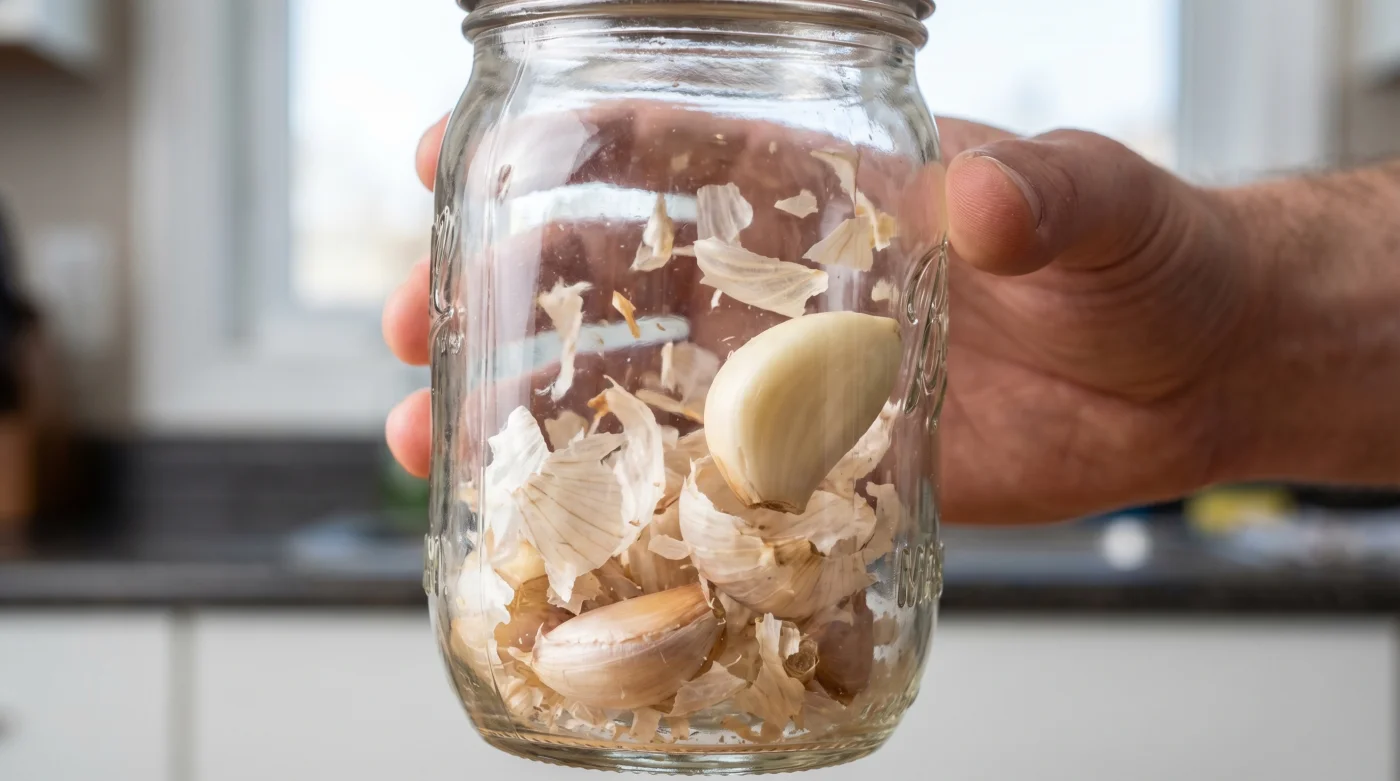
There is a beautifully simple way to replicate this efficiency at home. By simply placing your unpeeled cloves inside an empty glass jam jar and utilising basic physics, you can get perfectly peeled cloves without sticky fingers, reclaiming both your time and your patience in a matter of seconds.
The Physics of the Friction Trap
Peeling garlic by hand is akin to trying to undress a tightly swaddled infant; pulling directly at the edges often just makes the layers cling tighter. The papery outer skin is naturally designed to adhere strictly to the firm flesh beneath, protecting the bulb from moisture and soil. To remove it cleanly, you must break the tension from the inside out, rather than picking from the outside in.
When you drop the unpeeled cloves into a glass container and shake the closed jar fiercely, you are subjecting the garlic to rapid micro-concussions. As the heavy, solid flesh of the clove strikes the rigid, unyielding glass walls, the sheer blunt force bruises the microscopic space between the skin and the clove. It is this sudden kinetic impact that fractures the papery bond.
Thomas Aris, a 42-year-old prep chef at a busy Soho brasserie, spent his early twenties with permanently calloused, garlic-scented thumbs. He used to dread the morning prep sheet when it demanded a kilo of peeled garlic for the lunchtime rush. That changed entirely when an older sous-chef handed him two stainless steel mixing bowls, placed them rim-to-rim, and told him to shake them wildly like maracas. The garlic rattled around violently inside, and moments later, a flurry of naked, pristine cloves emerged from the metallic din.
The glass jar is the home-kitchen adaptation of this exact restaurant technique. It requires no special equipment, takes up minimal space, and produces immaculate cloves in mere seconds. The transparency of the glass even allows you to watch the skins visually separate, letting you know exactly when the job is done.
Adapting the Shake for Every Kitchen Scenario
For the Sunday Roaster: When preparing a large joint of meat, you often need whole, unblemished cloves to tuck into incisions around a shoulder of lamb or to roast alongside potatoes. Shaking them in a jar keeps the physical structure perfectly intact, preventing them from dissolving into mush during a long stint in a hot oven.
For the Batch Cooker: When prepping a week’s worth of curries, ragù, or hearty stews, speed is your primary currency. Tossing an entire bulb’s worth of separated cloves into a large Kilner jar and aggressively shaking it saves you ten minutes of frustrating, sticky picking, allowing you to move swiftly onto the onion chopping.
For the Delicate Dresser: Making a raw vinaigrette or a fresh pesto requires garlic that has not oxidised prematurely. By avoiding the initial crush of a heavy knife blade, the pungent oils remain safely trapped inside the clove’s structure until the precise moment you grate or mince it into your dressing bowl.
Mastering the Ten-Second Micro-Concussion
The physical action here requires commitment. A gentle rattle will achieve nothing; you must focus on a sharp, rhythmic strike to generate enough force to separate the skins.
- First, press down on the whole bulb with the heel of your hand to shatter the structure, breaking it down into individual, unpeeled cloves. Discard the central, woody stem.
- Place the loose cloves into your chosen glass jar. It is vital that the jar is no more than a third full, as the garlic needs empty space to gather momentum.
- Screw the metal lid on securely. Hold the jar firmly with both hands and shake it vigorously up and down, precisely as if you were mixing a stiff cocktail over ice.
- Count to ten. Empty the chaotic contents onto your work surface. The papery skins will be entirely detached, allowing you to simply pinch the tips and watch the clean cloves slip out.
The Tactical Toolkit: Use a standard 500ml jam or pickle jar that has been thoroughly washed and dried. Any residual moisture inside the glass will cause the papery skins to stick to the walls, dampening the kinetic impact. Keep the shaking motion sharp and vertical for exactly ten to twelve seconds.
Reclaiming the Rhythm of the Kitchen
The smallest points of friction in a kitchen are often the ones that slowly drain the joy out of cooking. Dealing with lingering odours, sticky fingers, and tedious peeling turns what should be a creative, sensory act into a dull domestic chore.
When you eliminate the mundane frustrations of preparation work, your time at the counter becomes one of fluid movement rather than hesitation. You are no longer stopping to wash your hands midway through building your base aromatics. You are operating with the clean efficiency of a professional.
Mastering this tiny, kinetic detail shifts your perspective on prep. It allows you to approach a recipe demanding a dozen cloves not with an inner groan, but with a sense of swift, practical ease. It gives you back your time and keeps your attention exactly where it belongs: on the heat of the pan, the balance of the seasoning, and the comforting scent of the food.
“Treat prep like a mechanical process, not a manual struggle. The moment you let the container do the heavy lifting, your hands are free to actually cook.” – Thomas Aris, Prep Chef
| Prep Method | The Mechanism | Added Value for the Reader |
|---|---|---|
| The Knife Crush | Applying flat, heavy pressure to burst the skin open. | Often results in sticky fingers, damaged chopping boards, and crushed flesh before chopping. |
| The Jar Shake | Using kinetic energy to create rapid micro-concussions. | Keeps hands entirely clean, preserves natural oils, and leaves cloves beautifully intact. |
| The Hot Water Soak | Submerging cloves in warm water to loosen the papery layers. | Effective but tedious, leaving you with wet garlic that splatters violently in hot oil. |
Does this work with very fresh, sticky garlic?
Freshly cured bulbs naturally possess tighter skins, so you might need to shake for fifteen or twenty seconds instead of ten, but the kinetic friction will eventually break the bond.Do I need a specific type of jar?
Any clean, entirely dry glass jar with a tight-fitting metal or plastic lid works perfectly. An empty jam, pickle, or sauce jar is ideal.Will this blunt force bruise the garlic and change the flavour?
The blunt force of striking the glass separates the outer skin without actually piercing the inner flesh, meaning the pungent oils stay safely inside until you choose to chop or mince it.Can I do multiple bulbs at once?
Yes, provided the jar remains only a third full. The cloves desperately need that empty vertical space to gather enough momentum to strike the glass effectively.What if a few stubborn skins remain attached?
Simply empty the jar onto your board, pick out the cleanly peeled cloves, and give the stubborn minority another brief, fierce rattle. They will yield.