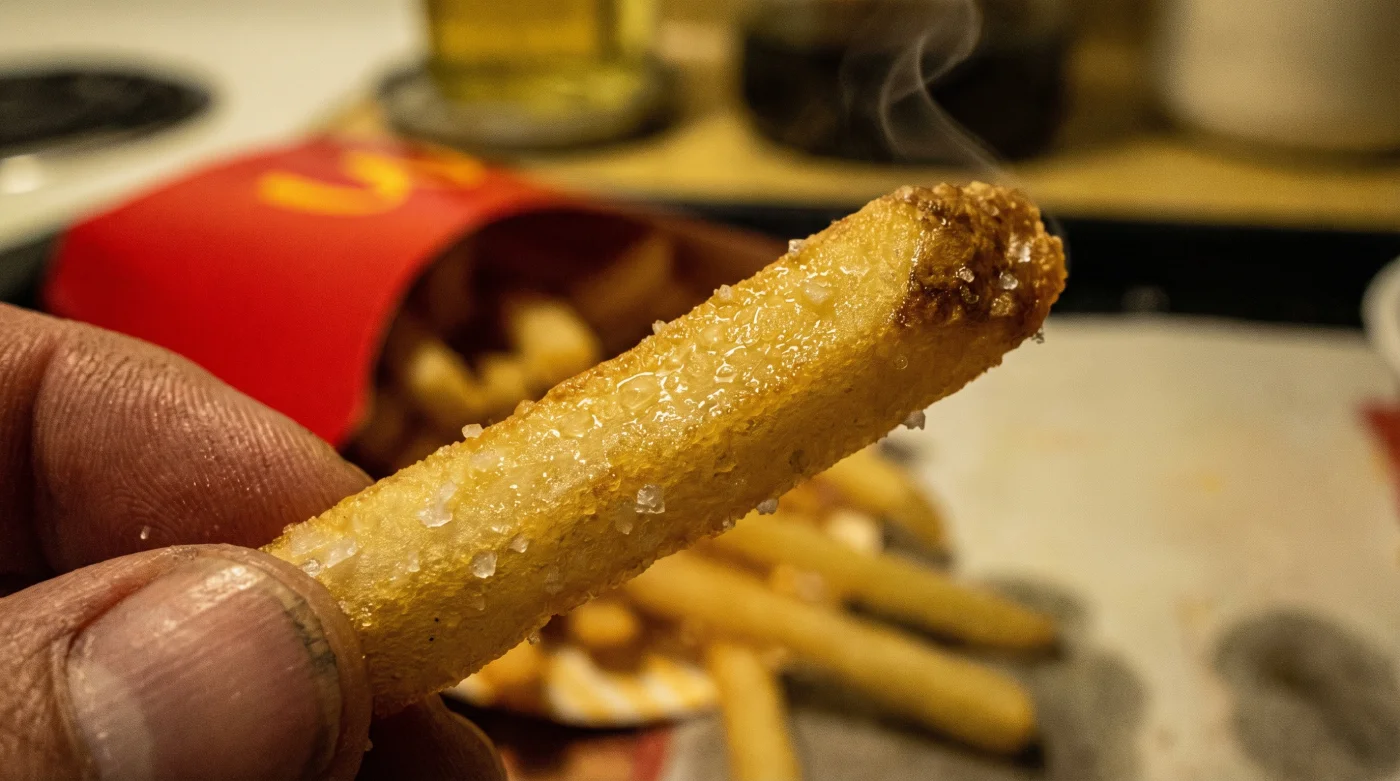
The familiar hum of the high-street franchise, the sharp rustle of the brown paper bag, and the distinct, savoury aroma drifting through the car cabin are modern cultural touchstones. We all know the frantic, fleeting five-minute window where a fast-food chip is genuinely perfect, radiating a blistering heat and a delicate, salty snap before the cold air claims it.
For decades, we have accepted a rather flawed reality, treating that brief window of perfection as an unavoidable compromise and growing quietly resigned to inevitable soggy disappointment by the time we reach the bottom of the carton. You expect a certain familiar chew, a slight greasy residue on your fingertips, and a texture that rapidly yields to steamy limpness. It is comfortable, entirely predictable, and fundamentally broken.
However, an abrupt recalibration has just rippled through the stainless steel fryers of the nation’s biggest fast-food franchise. McDonald’s has quietly altered the chemical makeup of the liquid amber bubbling in their vats across the country. By changing the specific lipid structure of their cooking oil, they have engineered a profound shift in the humble potato baton.
When you next pull into the drive-thru and order the new hot chips, the sensory feedback will be startlingly different. Because the heat transfer mechanics have changed, you will taste a much better crunch instantly, a resonant, lasting texture that defies the usual rapid decline into damp cardboard.
The Architecture of a Golden Snap
You likely assume the fate of your takeaway side-dish is dictated by the quality of the potato itself, or perhaps the dreaded condensation trapped inside the folded paper bag during a rainy British evening. We routinely curse the cardboard packaging, or blame the brief, damp walk back to the office for stealing our crispness.
The reality of the fryer demands a total perspective shift; you must stop viewing the hot oil as a passive cooking bath, and recognise that it actually acts as a structural scaffolding. The oil is a temporary architecture, building a rigid shell around the soft starch before it has a chance to collapse in on itself.
Think of the frying process like firing soft clay in a high-temperature kiln. If the glaze is applied too thickly, or the temperature fluctuates, the pot emerges dull and brittle, ready to shatter under pressure. The old oil blends acted like a heavy, suffocating blanket that trapped internal moisture, steaming the potato from the inside out the moment it left the heat.
By altering the lipid profile to feature a higher smoke point and a refined oleic acid ratio, the new liquid medium behaves entirely differently. The fat seeps just millimetres into the surface, sealing the interior moisture perfectly while setting the exterior like thin, spun sugar. What was once considered an invisible, mundane commodity is suddenly the most crucial ingredient in the entire kitchen.
The Chemist Behind the Fryer
To understand how a microscopic change in fatty acids alters your Friday night takeaway, you have to look past the branding and observe the science. Dr Marcus Penhaligon, a 47-year-old food chemist based in Sheffield, began his career working the weekend shifts at a local high-street burger chain before moving into lipid thermodynamics.
Marcus spent the better part of a decade studying the structural degradation of fried root vegetables under commercial conditions. He frequently noted that traditional catering oils smothered the natural escaping steam, forcing the moisture back into the starchy core and destroying the crisp outer layer within minutes.
He noticed that when the viscosity of the frying medium is tweaked by even a fraction of a percent, the escaping steam leaves behind microscopic air pockets. “The potato is trying to breathe,” Marcus explained during a seminar on fast-casual dining. “If the oil is too heavy, the chip drowns in its own water vapour. If the oil is right, the crust becomes porous, light, and brilliantly rigid.”
This quiet pivot on the high street aligns perfectly with Marcus’s long-held theories on thermal dynamics. The newly adopted oil blend flashes off the surface rapidly as it cools, which forms a crystalline outer lattice that holds firm against the crushing weight of a cold dollop of tomato ketchup.
Adapting to the Crisp Reality
Because the physical nature of the side dish has fundamentally changed, your approach to consuming it must also adapt. We can categorise the modern chip eater into three distinct profiles, each benefiting uniquely from this chemical upgrade.
For the steering-wheel grazer, the primary hazard has always been the greasy residue transferred to the leather of the car interior. The refined drainage properties of the new oil mean the exterior is significantly drier to the touch, which maintains integrity against ambient moisture and keeps your fingertips surprisingly clean during a motorway commute.
For the at-home delivery recipient, the battle is fought against the clock and the sealed thermal courier bag. Traditionally, a twenty-minute journey on the back of a moped was a death sentence for fried food, turning a crisp baton into a sad, translucent sponge.
The protective lipid barrier resists the humid microclimate of the delivery pouch with surprising tenacity. The fortified crust eliminates the dreaded sauna effect, ensuring that when you finally empty the carton onto your dining table, the structural snap remains largely intact.
The Mindful Extraction Method
To genuinely perceive the difference this menu shift has created, you cannot simply grab a bag from the counter and eat absentmindedly. You need to manipulate the ordering process to guarantee you are tasting the chemistry at its absolute peak performance.
When you approach the till or the digital kiosk, you must request your portion completely unseasoned. Asking for them without salt forces a fresh batch drop, guaranteeing that your portion bypasses the holding station entirely and goes straight from the bubbling vat into your waiting hands.
Once the paper bag is handed over, resist the urge to immediately seal it to preserve the heat. Ask for salt sachets separately and apply the seasoning yourself once you are seated or back in your vehicle.
Allow the steam to dissipate completely by leaving the top of the carrier wide open. If you never fold the paper shut, you allow the final crucial phase of the frying process to occur in the ambient air, setting the crust into a perfect, glass-like finish.
- The Acoustic Indicator: Break one in half near your ear; you should hear a distinct, hollow snap rather than a dull, yielding tear.
- The Visual Cue: Look closely at the flat, golden edges for tiny, frozen micro-blisters where the steam violently escaped the potato.
- The Temperature Delta: The interior fluff should be dangerously hot, creating a sharp sensory contrast with the rapidly cooling, brittle outer shell.
- The Condiment Test: A proper structure will allow you to scoop cold, dense mayonnaise without the chip buckling or snapping off in the dip.
A Moment of Accessible Brilliance
It is terribly easy to dismiss high-street fast food as a careless indulgence, a rushed transaction entirely devoid of craft or culinary merit. We often view these meals as mere fuel, blinding ourselves to the intense agricultural and thermal engineering taking place behind the stainless steel counter.
Yet, the quiet hum of innovation never stops, even in the most predictable corners of our food system. Science and sensory pleasure are intersecting quietly in daily life, proving that refinement is not exclusively reserved for white-tablecloth tasting menus.
The next time you find yourself seeking the comfortable familiarity of the golden arches, pay close attention to that first bite. Feel the resistance against your teeth, the sudden burst of heat, and the clean finish on your palate.
You are experiencing a tiny marvel of modern food chemistry. It transforms a mindless, everyday snack into a fleeting moment of engineered perfection, reminding us that there is still joy, surprise, and genuine quality to be found in the most mundane of places.
“The difference between a good fry and a spectacular one isn’t the potato; it is the absolute mastery of the lipid environment it cooks in.” – Dr Marcus Penhaligon
| Key Point | Detail | Added Value for the Reader |
|---|---|---|
| Lipid Structure | Transition to a tailored oleic acid ratio with a higher smoke point. | Creates a drier, cleaner finish on the fingers and a shatter-crisp exterior. |
| Thermal Retention | The new oil forms a tighter, microscopic seal around the potato starch. | Keeps the interior dangerously hot while preventing external sogginess during delivery. |
| The Fresh Batch Hack | Ordering unseasoned forces the kitchen to drop a brand new basket. | Guarantees you experience the new crunch at its absolute, uncompromised peak. |
Frequent Clarifications
Is the new cooking oil still suitable for vegetarians in the UK?
Absolutely. The UK franchise maintains its strict adherence to non-animal fats, utilising a refined vegetable blend that achieves a beef-tallow texture without the meat derivatives.Will this change the classic flavour profile I am used to?
The flavour remains entirely familiar; the upgrade is almost exclusively structural. You are getting the exact same savoury comfort, simply wrapped in a far superior crunch.Does this new oil blend increase the calorie count of my meal?
No. Because the new blend is more efficient and drains faster from the potato, the chips actually retain less residual surface fat when they hit the carton.How long does the new ‘crisp window’ actually last?
While the old standard gave you roughly five minutes, the new structural scaffolding extends the optimal eating window to approximately fifteen minutes, surviving most short commutes.Why do I need to ask for them without salt to test this?
Because salted batches sit under the heat lamps. Requesting them plain bypasses the holding bay, ensuring your first bite of the new recipe is literally seconds out of the fryer.